Ol Chiki Script at 100: A Milestone in Tribal Linguistic Heritage
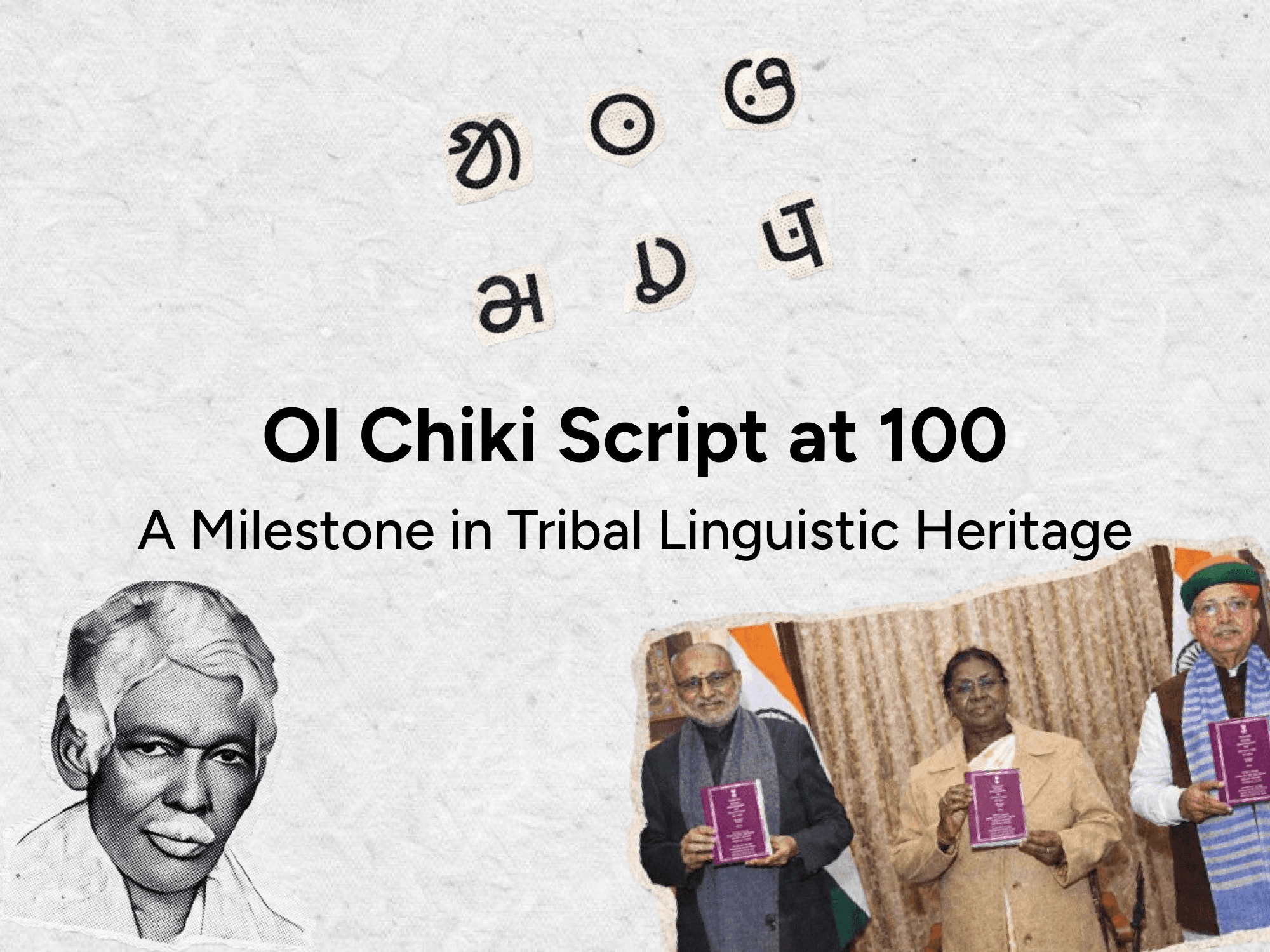
The Ol Chiki script stands as a monumental symbol of linguistic autonomy and tribal pride, marking exactly one hundred years since its inception in 1925. Often referred to as Ol Chemet’, Ol Ciki, or simply Ol, this script is the official writing system for Santhali, an Austroasiatic language spoken by over seven million people across India, Bangladesh, Bhutan, and Nepal. Recent celebrations in Jamshedpur, attended by President Droupadi Murmu, have brought global attention to this unique alphabet, highlighting a century of cultural renaissance and the ongoing struggle for educational integration.
The Genesis of a Script: Pandit Raghunath Murmu’s Vision
The story of Ol Chiki begins in the Mayurbhanj district of present-day Odisha. It was the brainchild of Pandit Raghunath Murmu, a visionary writer, teacher, and cultural reformer affectionately known as Guru Gomke (the Great Teacher). Before the invention of Ol Chiki, the Santhali language was written using a variety of non-native scripts, including Bengali, Devanagari, Odia, and Roman. However, these scripts were fundamentally ill-suited for Santhali phonology, failing to capture unique sounds such as glottalised consonants and specific vowel nuances.
Pandit Murmu recognised that for the Santhali people to preserve their identity and folklore, they required a script designed specifically for their tongue. He famously declared the creation of the script at a conference in Chemenjuri village in 1925. According to The Making Of Santali Ol Chiki Script, the audience initially responded with little enthusiasm, leaving Murmu demoralised. However, he persisted, eventually showcasing the script publicly at the Mayurbhanj State Exhibition in 1939. His efforts transformed Santhali from a largely oral tradition into a written literary culture, enabling the publication of novels, plays, and dictionaries.
The Architecture of Ol Chiki: A Mirror of Nature
One of the most remarkable features of Ol Chiki is its alphabetical nature. Unlike most Indic scripts, which are abugidas (syllabic), Ol Chiki is a true alphabet where vowels are given equal representation with consonants. The script consists of 30 letters - six vowels and 24 consonants - and is written from left to right.
The design of the characters is deeply rooted in the Santhal worldview. According to the Banaras Hindu University, the shapes are derived from natural objects, basic elements like fire and water, and everyday human postures. For example:
The letter 'Ol' (representing the sound /l/) is shaped like a hand holding a pen, as 'ol' is the Santhali word for writing.
The letter 'Ag' is inspired by a vomiting mouth, producing a sound similar to its name.
The letter 'Laa' reflects the shape of someone working in a field with a spade.
The letter 'At' is designed to represent the Earth.
This phonetic precision and intuitive design make the script highly accessible for first-generation learners. Additionally, the script employs several modifier marks, such as the mũ ṭuḍăg for nasalisation and the găhlă ṭuḍăg baseline dot to extend vowels, ensuring that every nuance of the Santhali dialect can be accurately recorded.
A Century of History and Constitutional Milestones
The path to official recognition for Ol Chiki was long and paved with dedicated grassroots activism. Following its 1939 debut, the script was promoted through songs, drama, and poetry as activists travelled from village to village across Bihar, Assam, and West Bengal. Organisations like the Adibasi Socio-Educational Cultural Association (ASECA) played a pivotal role in disseminating knowledge and establishing the script in the community’s consciousness.
A watershed moment occurred on 22 December 2003, a date now celebrated as Parsi Jitkar Maha. On this day, the Indian Parliament passed the 92nd Constitutional Amendment Act, which added Santhali to the Eighth Schedule of the Constitution. This granted Santhali official status and recognised Ol Chiki as its official script, mandating that the Indian government undertake the development of the language. This inclusion allows students to use Santhali for school examinations and entrance tests for public service jobs, significantly boosting the language's social and administrative standing.
The Digital Frontier and AI Innovation
As we move further into the 21st century, Ol Chiki has transitioned from wooden stamps to digital screens. The script was added to the Unicode Standard in 2008, making it possible for the Santhal community to communicate via social media, email, and mobile messaging.
Recent innovations have further refined the script for the digital age. Historically, Ol Chiki was unicameral, meaning it did not distinguish between uppercase and lowercase letters. However, a graphic designer named Sudip Iglesias Murmu has developed lowercase forms to increase typing efficiency and bring the script in line with bicameral systems like the Roman alphabet. This development aims to harmonise the Chapa (print) and Usara (cursive) styles of writing.
Furthermore, researchers are using Artificial Intelligence to ensure the script's longevity. Scholarly work has proposed frameworks for Handwritten Ol Chiki Character Recognition (HOCCR). By using Convolutional Neural Networks (CNN) and Histogram of Oriented Gradient (HOG) feature descriptors, these systems can recognise handwritten Santhali characters with over 90% accuracy. This technology is vital for digitising historical manuscripts and enabling modern handwriting-to-text applications for the tribal community.
Current Status: The Educational Divide
Despite its constitutional status, the implementation of Ol Chiki in primary education remains a point of contention. In West Bengal, the script has been institutionalised for decades, with over 350 schools using it as a medium of instruction. Assam has also recently made strides in including Ol Chiki in its school curriculum.
However, one report highlights concerns regarding Jharkhand and Odisha. Although both states have significant Santhal populations and are currently led by Santhali Chief Ministers, they have been criticised for delays in comprehensively introducing the script at the primary school level. While Odisha's Multilingual Education (MLE) for Tribal Children programme aims to use mother tongues in early grades to reduce language barriers, experts call for more serious policy implementation to match the script's official recognition.
The Centenary and the Role of President Droupadi Murmu
The year 2025 marks the Centenary of the Ol Chiki script, an event of profound national significance. The celebrations culminated in a high-profile event in Jamshedpur, Jharkhand, attended by the President of India, Droupadi Murmu. As the first tribal woman to hold India's highest office and a member of the Santhal community, her presence was deeply symbolic.
President Murmu used the occasion to release the first-ever translation of the Constitution of India into the Santhali language, written in the Ol Chiki script. She emphasised that having access to the nation’s founding document in their own language provides the Santhali people with a sense of strength, dignity, and a clearer understanding of their fundamental rights. The President’s involvement highlights the government's commitment to inclusive cultural nationalism and the preservation of indigenous heritage under initiatives like Ek Bharat Shreshtha Bharat.
Conclusion: The Road Ahead
A century after Pandit Raghunath Murmu sat down to derive letters from the world around him, the Ol Chiki script has become an inseparable part of India’s linguistic tapestry. It has survived the era of colonial indifference, achieved constitutional recognition, and is now navigating the complexities of the digital and AI revolutions.
While challenges in primary education policy persist, the centenary celebrations have reaffirmed that Ol Chiki is more than just a set of symbols—it is a vessel for the Santhal worldview, folklore, and identity. As President Murmu noted, the ability to read the laws of the land in one's mother tongue is the ultimate marker of citizen empowerment. As Ol Chiki enters its second hundred years, it remains a vibrant testament to the power of linguistic self-determination and the enduring legacy of Guru Gomke.
Set a post URL in the Properties.